Mythos Visits: Kos
- mythossubmissions
- Nov 30, 2025
- 14 min read


This year Mythos was lucky enough to visit the incredible island of Kos – a Greek island in the Aegean Sea only a short boat ride from Turkey’s port town of Bodrum. With its hot climate and gorgeous beaches, it’s easy to see why over a million tourists are said to visit the island annually. This influx of visitors to the island is far from new – during the Hellenistic period, Kos’ location made it a bustling hub for trade, though it is believed that life on the island stretches much further back, with evidence of human settlements as far back as the Bronze Age.
Of course, we couldn’t visit an island with such a rich and vibrant history without checking it out and there was plenty of history to find within the streets of Kos’ capital city, the appropriately named Kos Town. Surrounded by the busy roads, modern houses, and tourist restaurants of the port city are ancient ruins, Roman houses and one very special tree.
That is, of course, if one is able to find them. This was our first challenge upon arriving in the town. Our hotel, it seemed, was the only one in the area that didn’t equip its tourists with helpful maps of the city – certainly everyone we asked had gotten theirs from their hotel. Armed only with a blurry photograph of another tourist’s map (and no phone data) Mythos headed off into the city in search of the ancient sites.


The first that we managed to stumble upon was the West Archaeological Site. Separated from a busy road by a metal fence and an open gate, the site is free for entry – something many of the archaeological sites of Kos Town share, with one exception being the Casa Romana (which we visited later in the day).
Walking down some rather steep steps and on to a bed of thick pine needles, Mythos found ourselves completely surrounded by history. Much of the site was freely accessible – the only roped off areas being the mosaics which were covered and inaccessible to protect the delicate pictures that still remain. This meant that visitors could walk – or in some places even scramble or climb – around crumbling chunks of carved stone, fallen pillars, and the remnants of buildings, with only one stone arch remaining stubbornly upright. Despite being the middle of Kos Town (and only a few steps away from a busy road) it was easy to feel the tranquillity and natural beauty of the site. Tall trees and plants littered the area, attempting to reclaim the uncovered stone. A tree grew from the top of a stone tower near that stubbornly standing archway, white marble pillars tangled in the vines and purple flowers of morning glory that had attracted large numbers of yellow butterflies. It was easy to forget the busy streets that surround the area.
While there were many benefits to being able to just enter and wander the site there was one major drawback – especially if you’re a fan of history. Unfortunately, the Western Archaeological Site was almost completely unlabelled, the handy signs normally filled with a site’s history missing. Anyone seeking that information would have to look it up separately. Thankfully amidst the fallen stone the site included some remains that could be easily recognised – including ruins from throughout the town’s varied history, stretching back from the Hellenistic period of 4th Century BC up until the medieval period of 5th Century AD.
Some of the many hidden historical sites of Kos Town were revealed after a large earthquake hit the region in 1933, destroying much of Kos Town. Archaeologists L. Laurenzi and K. Lorricone would undergo excavations uncovering archaeological sites across large areas of the city. The ruins that would become known as the West Archaeological Site were uncovered between 1936 and 1940 and are located in the New Thermal District (something that would certainly have been useful information to have, had we been able to acquire a map). Among its ruins can be found The Western Baths, a ‘Nymphaeum’ (A rather tongue-in -cheek name for what was actually a 3rd Century Roman toilet), two early Christian basilicas, and three buildings playing host to the preserved mosaics that we mentioned earlier.
The largest of these areas is the Western Gymnasium, located at the far end of the site, easily identifiable from the metal covers which keeps the mosaics sheltered from sun, rain, and disrespectful tourists. Built during the Hellenistic period – and as such, one of the older buildings of the site – the Western Gymnasium’s remarkably well-preserved mosaic floor is one of the largest to have been uncovered in Kos.
The mosaic floor would have once displayed three panels, each surrounded by images of man and beasts locked in battle. The right panel is damaged, while the central panel holds some remnants of a centaur. The clearest panel still remaining is the left-most panel, which displays the Judgement of Paris, framed by images of Apollo and his nine Muses.
The Judgement of Paris is an event that would lead to the Trojan War, Paris’ own death, and the destruction of the city of Troy. The story goes that at the wedding of the sea nymph Thetis (mother of the Trojan War’s famous Achilles) and the mortal king Peleus, Eris, goddess of discord was not invited. Furious to be spurned, the goddess threw a golden apple into the midst of the party-goers, inscribed with the words ‘to the fairest’ (though this may have been a later addition to the myth). The goddesses Aphrodite, Hera, and Athena all argued over which of them the apple was intended for. Finally, it was decided that their beauty would be judged by Paris, a mortal man who had a reputation for fairness.
Ironically, there was nothing fair about the contest – each goddess attempted to bribe Paris in their own way. Hera offered to make him a mighty king, Athena offered victory in battle and Aphrodite offered the most beautiful woman in the world – the already married Helen, who’s abduction at Paris’ hands would spark the Trojan War. Swayed by Aphrodite’s bribe, Paris declared her the winner and earned himself the enmity of the other two goddesses.
It is this scene that is depicted in the gymnasium’s mosaic; Paris, watched over by a seated Hermes as he declares Aphrodite the winner. There is a certain irony in the scene. While Athena in her distinct helm and a crowned Hera are still visible in the mosaic, time has worn the ‘most beautiful’ Aphrodite away, her face no longer visible.
In the bracketing panels featuring the Muses some share this same fate – worn away over time. Of the nine, only a few can still be clearly seen, surrounding the central figure of Apollo.
Clearly visible, the god is seated with a crown of leaves and a lyre. To his left, the Muse Thalia still remains, dressed in blue and white. The Muse of comedy and idyllic (short and typically depicting a rural scene) poetry, Thalia holds a comic mask in one hand. In her other hand she holds a shepherd’s staff – a link to the rural nature of the poetry she patroned.
Next to her and wearing frowning pair to Thalia’s comic mask is likely Melpomene. While much of the Muse’s body has been worn away her face, and the mask that she wears on her head like a helmet are both still visible. Much as Thalia represented comedy, Melpomene represented tragedy.
To the other side of Apollo, we can see two further Muses. The furthest of these, Clio, was the Muse of history and recording great deeds. Only some of the Muse is visible, predominantly her dress and the open scroll that she was often depicted with. Her son Hyacinth would be one of Apollo’s doomed lovers – transformed into a flower upon his untimely death. Between her and Apollo is the Muse, Euterpe dressed in green and carrying an aulos or a ‘double flute’. Euterpe is the Muse of music and lyric poetry.
Sadly, the five Muses on the far side of the mosaic have fared worse over the years and were harder to make out. That said, one remaining Muse may be Calliope, eldest of the Muses and mother of Orpheus. She was the Muse of epic poetry – a particularly important Muse when we consider the works of Homer.
Though the mosaics of the Western Gymnasium may be the largest found here, at the other end of the Site are two Roman houses, the House of Silenus and the House of Europa, who also boast their own surviving mosaics. As is typical in such cases, these buildings were named for the subjects of the mosaics they house. The House of Europa features a scene of the god Zeus, abducting Europa in the form a bull. Zeus had transformed into the creature to entice the young woman onto his back, and then spirited her away to Crete. Europa would eventually bear Zeus three sons – Minos, the famous king from the tale of the Minotaur, and the less famous Radamanthys and Sarpedon.
In the House of Silenus we can see the aforementioned Silenus, astride his mule, alongside a second panel featuring gladiators and their trainer. A Satyr – and sometimes said to be the father of satyrs – Silenus is said to have looked after Dionysus as a youth, entrusted with the safety of the young demigod by Dionysus’ half-brother, Hermes (an important task, as Zeus’ wife Hera would try multiple times to rid the world of her husband’s illegitimate son). Even after Dionysus was grown, Silenus remained a close companion of the god, and was known for his own drunkenness and merriment. On one occasion a drunken Silenus wandered off and was found by the tragic king, Midas, who took him in. Impressed by Midas’ hospitality and grateful for his treatment of his companion, Dionysus offered Midas a boon – Midas famously (and with a stunning lack of foresight) requested that all he touched would turn to gold, with obvious and disastrous consequences.
While the Western Archaeological Site is impressive, it is far from the only impressive site in Kos Town, and if you leave the site and take a short walk across the road you can find another incredibly preserved historical building – a Roman Odeon.


Originating from either the 2nd or 3rd century AD and able to host 750 people, the Roman Odeon of Kos Town shares many similarities to an ancient Greek or Roman theatre with its horseshoe shape and staggered seating. Theatres tended to be larger and open-air, they were also traditionally built into the landscape, taking advantage of natural slopes and hills for their distinct staggered shape. In contrast, an Odeon would typically have a roof – though unlike the stone seating and stage this has not withstood the test of time. They were also less likely to be built into natural surroundings, which is how we can have one located in the middle of Kos Town.
Another difference between the two is their utility. Where Theatres (as the name suggests) were typically used for plays, Odeons were more commonly used for performances of song (again, as the name suggests – Odeon deriving from the word ‘oda’ meaning song), as well as public senate sessions.
The oldest known Odeon can be found in Athens, and is the Odeon of Pericles which dates back to 466 BC. Though being from around the 2nd Century AD the Odeon of Kos Town is nowhere near that old, though its foundations may be older than the building. The Odeon is believed to have been built on top of a pre-existing Greek Odeon.
Interestingly, when the Odeon in Kos Town was discovered in 1929, a number of statues were found in the tunnels beneath the seats. This included pieces of statues believed to represent Zeus and Aphrodite, a statue of Aphrodite with Eros and a statue believed to be Hippocrates, which is now on display at the Archaeological Museum of Kos. Luckily for visitors interested in learning more about the history of the site and the excavation process, this site does have a lot of information, though the majority is now kept in the tunnels beneath the stage. Some areas are quite dimly lit, so if you are especially claustrophobic (or clumsy) this may pose something of a challenge.


Keeping with the Roman period, the next stop on our list was the Casa Romana – a restored Roman villa. Much like the Odeon, the villa dates to the 2nd century and is believed to have been built on top of earlier, Hellenistic buildings which had likely been destroyed by an earthquake in 142 AD. The villa was discovered after the earthquake of 1933 and has been restored, allowing visitors to walk around the building. Unlike the majority of the sites in Kos Town, the Casa Romana does charge an entrance fee of €6 and has opening times of 8:00am – 7:30pm, which does leave plenty of time to visit, though the site doesn’t open on Tuesdays.
The villa boasts three atriums (each consisting of an open courtyard with a shallow pool called an impluvium) surrounded by a total of thirty-six rooms. The open courtyards fill the rooms with light, and add a refreshing and calming feel to what would otherwise be rather dark rooms. One impluvium was still filled with water, and was home to a large amount of waterlily pads, if no flowers, and was surrounded by stunning mosaics, including spotted panthers, and a merman riding on a hippocampus – his face now destroyed.
With the remnants of frescos on the walls – including an image of Eros on the wall of a private antechamber – the rooms now hold displays of art and every-day objects of the period. These include amphora, coins, statues, and even funerary reliefs. Among the artwork are included a number of statues and statuettes believed to date back to the Hellenistic period. Though some, such as the Athena statue that would have stood in the main reception hall, have been removed and are now displayed in the Archaeological Museum of Kos, others remain, including a small statue of Aphrodite removing her sandal.
Much like its predecessor, this newer building is thought to have been damaged and partially destroyed by another earthquake. Despite this, however, parts of the building are believed to have remained in use until the end of the early Christian period.
Much as the Western Archaeological Site and the Odeon can be found opposite each other, if you head out of the Casa Romana, only a few minutes over the road you can find the remnants of an ancient altar to the god of wine, Dionysus.


The child of Zeus and the mortal woman, Semele, Dionysus was a god of wine, theatre, madness and festivity. One of his most famous stories is that of his birth. While pregnant, Semele was tricked by a jealous Hera (Zeus’ wife) who convinced Semele to request a promise from Zeus in order to prove that the god was who he said he was. Zeus agreed, and Semele requested to see Zeus’ true form. Bound by his oath, Zeus reluctantly did so – the power of his true form destroying his mortal lover. Though Semele died, Dionysus survived, with the god sewing Dionysus into his own thigh in order to carry him to term. After his birth, Hera would continue to attempt to murder her husband’s illegitimate son who would eventually fall into the care of the aforementioned Silenus – who's mural (which we visited earlier) can be found only about five-to-ten-minutes from Dionysus’ altar.
Little remains of what would have once been an impressive structure made of white and grey marble, though enough of the foundations remain to clearly see the typical Hellenistic Π-shape of the altar. The entrance faces to the left, where once a ramp would have led up to a sacrificial table where animals would be sacrificed to the deity. Friezes on the walls showed scenes of Dionysus’ myths – in particular his time with the Amazons, warrior women who Dionysus is in some myths said to have fought against, and in others said to have fought alongside.
As with many of Kos’ archaeological sites, the altar fell victim to an earthquake – the earthquake of 124 AD. The true nail in its coffin however came in the 15th century. In this time the Knights of Saint John – also known as the Knight Hospitaller – built a medieval castle overlooking Kos’ harbour. To build this temple they largely used what stones were already availably – taking marble from both Dionysus’ altar and Kos’ mighty Asklepion (which we will visit in our next article). Named Nerantzia – sour orange – for the abundant orange and lemon trees which grew in abundance in the area, the castle makes for a solid and imposing sight, almost entirely surrounded by the sea. Hints of its Dionysian origins remain – as you walk over a cool, shaded bridge towards the castle, a number of carved theatre masks can be clearly seen above the entranceway, just some of the carved stones taken from Dionysus’ altar. Other friezes have also been found embedded within the walls of the castle. They have since been removed and are now on display within that same castle.


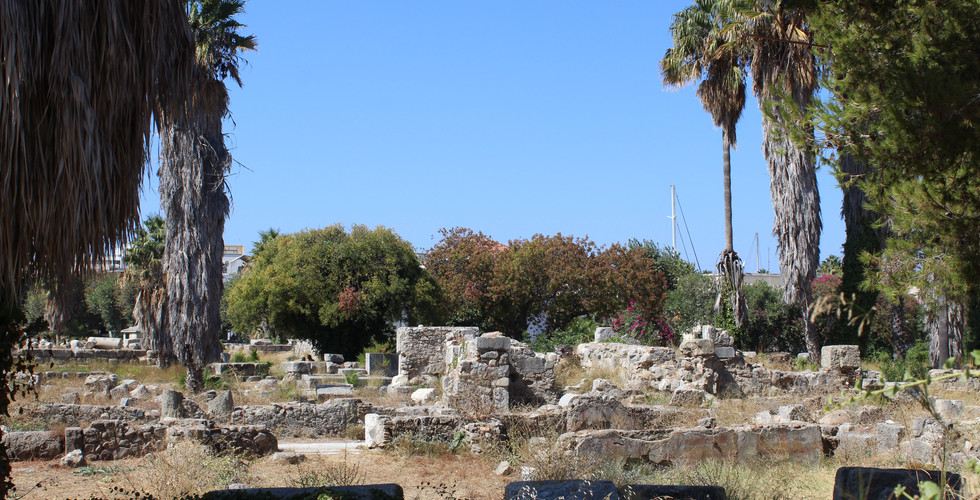


Having already visited the Western Archaeological Site, Mythos now found ourselves heading to the Eastern Archaeological site – which includes (among other things) the Ancient Agora, the Sanctuary of Hercules and the Sanctuary of Aphrodite.
An ancient marketplace close to the harbour, the Agora would once have served as a central hub for life in the city. It is believed to have first been built in the 4th century BC – though new buildings would be added, and the area expanded over the following centuries before the area was destroyed in an earthquake in the 5th Century AD. The agora of Kos is believed to have been once of the largest of its time. As with most of the sites we visited in Kos Town, the Agora was allowed to be partially reclaimed by nature, with beautiful trees and flowers growing in and around the site, encouraging a number of white-winged butterflies to take up residence amidst the old marble stone.
The sanctuary of Aphrodite is a later addition to the site, founded around the 3rd or 2nd Century AD – though it is possible that it was built atop an older temple. The temple actually included two different altars, once dedicated to Aphrodite Pandemos and the other to Aphrodite Pontia.
The Greek gods were believed to have many different aspects – Hermes for example was the god of thieves and also of travellers, Athena was a goddess of warfare, but also of crafts. The gods could therefore be called upon in relation to their different aspects, as indicated by the epithet associated with them. For example, Zeus Xenios may be appealed to in relation to his status as a patron of Xenia (the Greek code of hospitality) or as Zeus Ombrios – the bringer of rain.
In her form of Aphrodite Pandemos, Aphrodite was called upon as a goddess of harmony – specifically relating to the unity of a city and its inhabitants, though potentially also called upon for harmony in marriage.
The second aspect celebrated in Kos pays homage to the Aphrodite’s origins and her birth from seafoam. Aphrodite Pontia was called upon to protect seafarers – in particular those who made their living from the sea, such as merchants or sailors.
Almost a century older than the Sanctuary of Aphrodite is the Sanctuary of Hercules is believed to have originally been built around the end of the 4th Century BC – though later repairs and additions were made. The hero is said to have once visited the island, on his way home after completing his ninth labour – to retrieve the girdle of the Amazonian Queen, Hippolyta. A storm washed he and his crew off course and they were forced to take shelter on the island. Taking him for a threat, the islanders of Kos attached and Hercules fought back. After the conflict he is said to have married the king’s daughter who bore him a son. As such, Hercules is considered a forefather of the people of Kos.


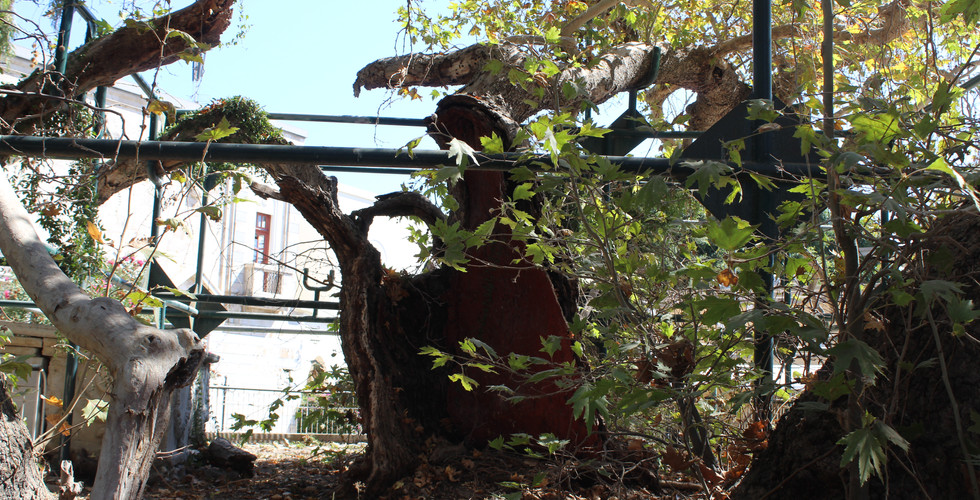


The final stop of our tour of Kos town was the famous Tree of Hippocrates – a plane tree found near the harbour and opposite the entrance to Nerantzia castle. It is said that the famous healer Hippocrates would sit beneath that tree and give lessons. Rather appropriately for a tree associated with the Father of Medicine, plane trees have historically been used for medicinal purposes. The leaves have been used treat burns, bites, and infections, while the bark has been used to treat indigestion and toothache.
Sadly, while the tree may certainly grow in the place that Hippocrates once sat, it cannot be the actual tree that once stood there – though it may be a descendant. Hippocrates lived in the 5th century BC, while the tree is believed to be closer to 500 years old, than thousands.
Despite this, the tree still makes for an impressive sight and is well worth the visit. Hippocrates’ tree is accompanied, and overshadowed, by a second, younger tree, both of which are enclosed within a sturdy cage. The cage serves to both to protect the tree, and to offer physical support to prevent the tree from buckling under its own weight. Over the years, the tree has suffered a great deal of damage, from both fungus and insects, leaving its impressive truck blackened and hollow – it is certainly a tree which looks every one of its 500 years (if not older).
Beneath the branches of the tree (and its neighbour) we found a pleasant shade from the warm day. Finches filled the branches, chattering loudly to the great interest of the numerous stray cats that had taken to basking in the dappled sunlight below. It was easy to imagine why Hippocrates might make the journey down from the Asklepion to sit beneath the tree with a faint breeze blowing in from the harbour and teach.
With our tour of Kos Town complete, Mythos headed back to the bus stop ready for an early night and an even earlier start for the next day. We’ll be back next time as we tour the ruins of Kos’ famous Asklepion – where Hippocrates himself learned and practiced medicine.
Thanks for reading! If you enjoyed it and would like to see more, please consider leaving us a tip on Ko-fi.


Comments